Ilhan Omar Investigation: Phone Seized, Relatives Subpoenaed
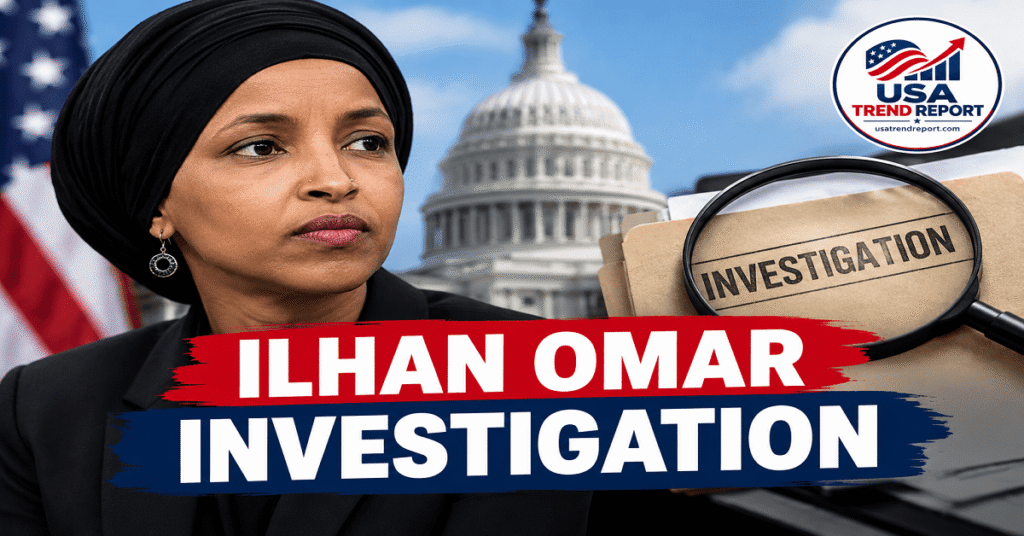
The Ilhan Omar investigation has become a major political and legal story in the United States in October 2026. Federal authorities have searched the Washington, D.C., home of Representative Ilhan Omar, examined questions related to her immigration history, and issued subpoenas to members of her family. The investigation has attracted national attention because Omar is a prominent Democratic lawmaker, a frequent critic of President Donald Trump, and a representative of Minnesota’s 5th Congressional District.
The case involves allegations concerning immigration documents from decades ago, questions about citizenship eligibility, and a separate inquiry into financial disclosures. Omar has rejected accusations of wrongdoing and described the investigation as politically motivated. Federal authorities, meanwhile, have indicated that the matter remains under investigation.
It is important to distinguish allegations from established facts. A search warrant, subpoena, or criminal investigation does not prove that a person committed a crime. As of October 15, 2026, the full scope of the investigation and its eventual outcome remain uncertain.
This article examines the latest developments, the allegations being investigated, Omar’s response, the political controversy, and the possible next steps in the legal process.
Who Is Ilhan Omar?
Ilhan Omar is a Democratic member of the United States House of Representatives from Minnesota. Born in Somalia, she came to the United States as a refugee with her family in 1995 and became a U.S. citizen in 2000.
Omar was elected to the Minnesota House of Representatives in 2016 before winning election to the U.S. House in 2018. She became one of the first two Muslim American women elected to Congress and the first African refugee elected to the House.
During her congressional career, Omar has focused on immigration, healthcare, economic inequality, foreign policy, and civil rights. Her political positions and public statements have also made her a frequent target of criticism from Republican politicians.
Her relationship with Trump has been particularly contentious. The two have repeatedly clashed over immigration policy and the treatment of immigrant communities. That political background has become part of the public debate surrounding the Ilhan Omar investigation, although political disagreements alone do not establish whether the legal allegations are justified.
What Is the Ilhan Omar Investigation About?
The investigation currently receiving the most attention concerns allegations that information on historical immigration paperwork may have been inaccurate.
According to reporting published on October 12 and 13, 2026, federal authorities are examining whether Omar or her late father provided incorrect information on immigration documents decades ago. Investigators are reportedly focusing on questions about her date of birth, her father’s immigration history, and the circumstances under which she obtained U.S. citizenship.
The inquiry has reportedly included consideration of possible immigration fraud, conspiracy, and false statements. These are potential areas of investigation, not findings that Omar has committed any offense.
The underlying documents date back to a period when Omar was a child. Establishing what happened would require investigators to examine historical records, determine who completed particular forms, and assess whether any inaccurate information was intentional and legally significant.
Such questions can be complicated because old immigration files may contain incomplete records, conflicting information, or documents prepared by someone other than the individual whose status is being examined.
The government would need evidence supporting any legal action it chooses to pursue. Public allegations and speculation cannot substitute for proof.
Federal Agents Search Omar’s Washington Home
One of the most significant developments occurred on October 12, 2026, when federal agents searched a Washington, D.C., residence associated with Omar.
The Department of Justice confirmed that Homeland Security Investigations had executed a judicially authorized search warrant as part of an ongoing federal investigation. Reports subsequently connected the search to the inquiry into her family’s immigration history.
The search brought the investigation into the national spotlight because it involved a sitting member of Congress just weeks before the November midterm elections.
By October 14, news reports also indicated that authorities had seized Omar’s phone and issued more than a dozen grand jury subpoenas, including subpoenas involving some of her relatives. These measures suggest that investigators are gathering evidence and seeking information from people who may have knowledge of relevant events.
However, the public does not have a complete account of all the evidence collected, the precise scope of the warrant, or the conclusions investigators may eventually reach.
A search warrant authorizes a search under specified legal conditions. It is not equivalent to an indictment, a criminal conviction, or a final determination that a law was violated.
The Ilhan Omar investigation therefore remains an ongoing legal matter, and its significance will depend on the evidence and any subsequent decisions by prosecutors or courts.
Allegations About Immigration Papers and Citizenship
The central immigration-related question concerns whether historical documents contained material inaccuracies that affected Omar’s eligibility for immigration benefits or citizenship.
Reports indicate that investigators are examining the possibility that her birth date or other details were misstated during the immigration process. Authorities have also reportedly examined aspects of her late father’s background and the information provided in his own immigration paperwork.
These questions matter because immigration and citizenship decisions depend on the information submitted to the government and the legal requirements applicable at the time.
Nevertheless, an inaccurate record does not automatically establish fraud. Investigators would need to establish relevant facts, including who supplied the information, whether it was knowingly false, and whether the law provides a basis for the proposed action.
The age of the documents may create additional challenges. Historical records can be difficult to verify, and investigators must distinguish reliable evidence from unsubstantiated claims that have circulated for years.
Omar has repeatedly denied allegations of immigration fraud. Her position is that the accusations are baseless and part of a broader effort to target her politically.
The government’s findings, if any, will need to be assessed through the appropriate legal process rather than assumed from the existence of an investigation.
The Separate Investigation Into Financial Disclosures
The immigration inquiry is not the only issue attracting attention. Another development concerns Omar’s financial disclosure forms.
According to reporting published on October 13, Washington, D.C., U.S. Attorney Jeanine Pirro said her office was also investigating questions related to the congresswoman’s financial disclosures.
The controversy followed an earlier filing that listed a substantial range of assets held by Omar and her husband. The filing reportedly valued their assets between $6 million and $30 million. Omar later amended the disclosure to report a much lower range, between $18,000 and $95,000, with her team attributing the discrepancy to accounting errors.
The figures have raised questions about the accuracy of the original filing and the process used to prepare the documents. Financial disclosures are intended to help the public identify potential conflicts of interest and understand lawmakers’ financial circumstances.
However, an amended disclosure or a large difference between reported figures does not, by itself, establish intentional misconduct. Investigators would need to examine the underlying financial records, the nature of the error, and the circumstances surrounding the original submission.
There is also an important distinction between a congressional ethics review and a criminal investigation. An ethics body considers whether conduct may violate congressional rules or standards, while criminal investigators assess whether the available evidence supports a potential violation of criminal law.
Reports indicated that a congressional watchdog had recommended dismissing allegations concerning Omar’s earlier financial disclosures. The separate inquiry announced by Pirro means that the issue may receive additional scrutiny, but it does not establish that a criminal offense occurred.
Readers following the Ilhan Omar investigation should therefore treat the immigration and financial matters as separate inquiries unless authorities establish a connection between them.
Omar’s Response to the Investigation
Omar has strongly criticized the federal search and the broader investigation. She has argued that the administration is using law enforcement to target a political opponent.
Following the October 12 search, Omar said the action represented another escalation in what she described as a long-running campaign of intimidation. She also maintained that she would not be silenced by the investigation.
Her response reflects the wider political conflict between the congresswoman and Trump, who has repeatedly criticized her publicly.
Omar’s supporters argue that investigations involving elected officials must be conducted impartially and that authorities should avoid actions that could create the appearance of political interference. They have questioned the timing of the search, particularly because the November midterm elections are approaching.
Critics of Omar, meanwhile, argue that elected officials should be subject to the same legal scrutiny as other citizens when credible allegations arise. From this perspective, political status should not prevent investigators from examining potentially relevant evidence.
Both principles are important to a functioning democracy. Public officials should not receive immunity from legitimate investigations, but law enforcement agencies must also follow legal requirements and avoid using their authority for partisan purposes.
The decisive questions are whether the investigation is supported by evidence, whether legal procedures are followed, and whether any eventual conclusions can withstand independent judicial scrutiny.
Why the Timing Before the Midterm Elections Matters
The timing of the search has become one of the most controversial aspects of the case.
The search took place on October 12, fewer than four weeks before the November 3, 2026, midterm elections. Omar is seeking reelection, making the public handling of the investigation particularly sensitive.
The U.S. Department of Justice has historically followed internal guidance intended to prevent investigative actions from improperly influencing elections. This practice is often discussed in connection with an informal 60-day period before an election, during which politically sensitive public actions are generally approached with particular caution.
This is not an absolute statutory prohibition on investigations during election periods. The precise application of internal guidance depends on the circumstances, and the timing alone does not establish that authorities acted unlawfully.
Nevertheless, public searches, announcements, and leaks concerning an active investigation can influence how voters perceive a candidate, even when no charges have been filed.
That is why critics have questioned whether the timing was appropriate. Administration officials, according to reporting, maintained that the search was authorized through the Justice Department’s legal process.
The controversy raises a broader issue: how can authorities investigate serious allegations while protecting the electoral process from the appearance or reality of political manipulation?
The answer depends on transparency where legally permissible, adherence to established procedures, and a clear separation between evidence-based law enforcement and political messaging.
Could Ilhan Omar Lose Her U.S. Citizenship?
One of the most serious possibilities discussed in reports is whether the government could attempt to challenge Omar’s citizenship if investigators establish that material misrepresentations affected her immigration status.
Such an outcome would involve complex legal questions. The government cannot simply cancel a person’s citizenship because allegations have been made or an investigation has been opened.
A denaturalization case generally requires the government to establish a legally recognized basis for revoking citizenship obtained through naturalization. The applicable legal standard depends on the specific grounds asserted and the circumstances of the case.
Omar became a U.S. citizen in 2000. Any attempt to challenge her citizenship would therefore require authorities to establish the relevant facts, identify an applicable legal basis, and follow the required procedures.
If the government pursued such a case, Omar would have an opportunity to contest the allegations in court. The court would evaluate the evidence and arguments under the applicable law.
It is also important to distinguish citizenship obtained through naturalization from citizenship acquired automatically through a parent under federal law. Reports about the investigation have raised questions about the circumstances of Omar’s citizenship, but the legal route and potential consequences cannot be determined from public allegations alone.
As of October 15, 2026, the reported investigation does not mean that Omar has lost her citizenship or that a court has ruled her citizenship invalid.
Any claim that deportation or denaturalization is inevitable would therefore be premature.
What Happens Next in the Ilhan Omar Investigation?
The next phase will depend on the evidence collected by federal investigators and the decisions made by prosecutors.
Several developments are possible.
First, investigators may continue examining immigration records, financial documents, electronic evidence, and information supplied by witnesses. The reported seizure of Omar’s phone and the issuance of grand jury subpoenas indicate that evidence gathering is underway, although the full scope of those efforts remains unclear.
Second, prosecutors may review the findings and decide whether the evidence supports criminal charges. A criminal investigation does not necessarily lead to prosecution. Authorities may conclude that the evidence is insufficient, that the relevant conduct does not violate criminal law, or that additional investigation is required.
Third, the financial disclosure inquiry may proceed separately. Its outcome could depend on accounting records, the explanation for the amended filing, and any evidence concerning how the original figures were prepared and submitted.
Fourth, if the government seeks to challenge citizenship, it would need to pursue the appropriate legal process. That possibility should not be confused with an immediate or automatic consequence of the ongoing investigation.
Finally, the case may generate additional political debate in Congress and during the midterm election campaign. Lawmakers may question the investigation’s timing, request information about Justice Department procedures, or defend the government’s authority to investigate potential wrongdoing.
Because the case remains active, details may change as additional information becomes public. Readers should distinguish confirmed actions, statements from the parties involved, and unverified claims circulating on social media.
Political Reactions and the Broader Debate
The investigation has become part of a larger national argument about immigration enforcement, executive power, and the independence of federal law enforcement.
For Omar’s supporters, the case raises concerns about whether government agencies are being used to intimidate critics of the administration. They point to the timing of the search and Trump’s repeated public criticism of the congresswoman.
For Omar’s opponents, the investigation presents an opportunity to demand answers about her immigration history and financial disclosures. They argue that elected representatives should be held accountable when questions arise about their official records.
However, political disagreement should not determine the outcome of a legal case. Evidence must be evaluated according to established legal standards, regardless of whether the person under investigation is a Democrat, a Republican, or an independent.
The public should also be cautious about claims that go beyond what investigators have established. Social media posts and partisan commentary can quickly transform an allegation into an apparent fact, even when the underlying evidence remains unavailable.
The Ilhan Omar investigation is therefore significant for more than its potential consequences for one member of Congress. It also tests public confidence in the fairness, independence, and credibility of American institutions.
Conclusion
The Ilhan Omar investigation has developed into a high-profile legal and political controversy following the October 12 search of her Washington, D.C., home. Federal authorities are reportedly examining historical immigration paperwork and questions concerning her citizenship, while a separate inquiry has focused on her financial disclosures.
Omar denies wrongdoing and has characterized the investigation as political intimidation. Her critics argue that the allegations deserve scrutiny, while other lawmakers and observers have questioned the timing of the federal search so close to the midterm elections.
At present, the central distinction is between an investigation and a proven offense. Searches, subpoenas, and investigative inquiries are steps in a legal process; they are not findings of guilt.
The eventual outcome will depend on the evidence, prosecutorial decisions, and any court proceedings that follow. Until more information becomes available, the most responsible approach is to follow verified reporting, distinguish allegations from established facts, and avoid assuming what the final legal outcome will be.
Frequently Asked Questions
1. Why is Ilhan Omar under investigation?
Federal authorities are reportedly investigating allegations concerning historical immigration paperwork and whether information provided during the immigration process was accurate. A separate inquiry concerns her financial disclosure forms. Omar has denied wrongdoing.
2. Did federal agents search Ilhan Omar’s home?
Yes. Federal agents searched a Washington, D.C., residence associated with Omar on October 12, 2026, under a judicially authorized warrant. The search was connected in reporting to the ongoing immigration-related investigation.
3. Has Ilhan Omar been charged with a crime?
As of October 15, 2026, the publicly reported developments discussed in this article do not establish that Omar has been convicted of a crime. An investigation or search warrant does not itself prove criminal wrongdoing. Readers should check subsequent official announcements for any changes.
4. Could Ilhan Omar lose her U.S. citizenship?
The possibility of a legal challenge to her citizenship has been discussed in reporting. However, citizenship cannot simply be revoked because allegations exist. The government would need to establish a legally valid basis and follow the applicable legal procedures.
5. Is the Ilhan Omar investigation politically motivated?
Omar has described the investigation as politically motivated, and some Democrats have criticized the timing of the search before the midterm elections. Administration officials have said the search was legally authorized. Whether the investigation was conducted appropriately must be assessed using reliable evidence and the applicable legal standards.

I am a professional content writer and SEO specialist with experience in creating well-researched, accurate, and user-focused content. I write about technology, business, finance, automotive, lifestyle, and trending news. My goal is to provide readers with reliable, up-to-date, and easy-to-understand information while following Google’s content quality and editorial best practices.